

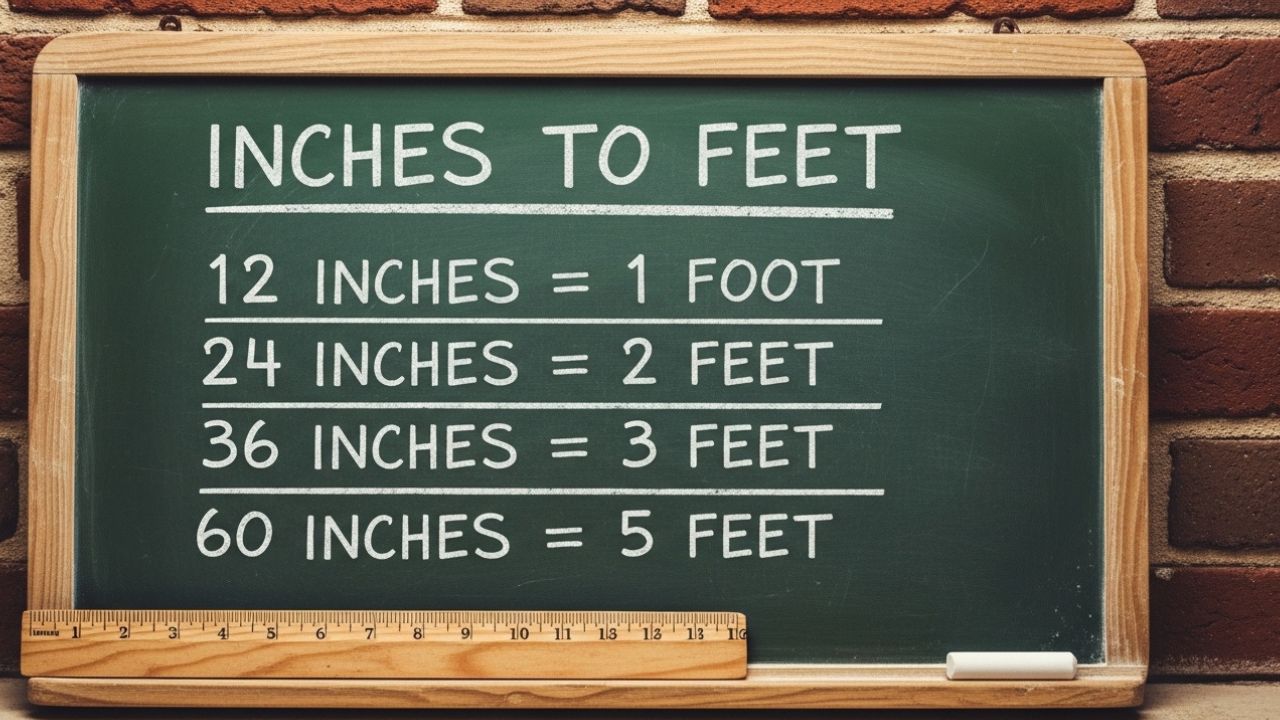
Understanding how to convert in ches to feet is a fundamental skill in measurements, whether you are working on construction projects, home improvement, interior design, or educational exercises. Since the imperial system uses both inches and feet for measuring length, knowing how to switch between the two units ensures precision and clarity in calculations.
In this article, we will explore the in to ft conversion, the exact formula, practical examples, tips for quick mental math, and common mistakes to avoid. By the end, you will confidently convert in ches to feet in any situation.
What Does “In to Ft” Mean?
The abbreviation in stands for inches, while ft stands for feet. Both are units of length used primarily in the imperial system.
-
Inches (in): Smallest common unit of length in the U.S. customary system.
-
Feet (ft): A larger unit where 1 foot equals 12 inches.
The conversion between inches and feet is simple but essential for accuracy in daily and professional measurements.
The Exact Formula for Inches to Feet Conversion
To convert in ches to feet, you use the following formula:
Feet=Inches12\text{Feet} = \frac{\text{Inches}}{12}
Explanation
Since 1 foot equals 12 inches, dividing the total number of inches by 12 gives the equivalent measurement in feet.
Step-by-Step Examples of In to Ft Conversion
Example 1: Convert 24
24÷12=2 ft24 ÷ 12 = 2 \text{ ft}
So, 24 inches = 2 feet.
Example 2: Convert 36
36÷12=3 ft36 ÷ 12 = 3 \text{ ft}
So, 36 inches = 3 feet.
Example 3: Convert 50
50÷12=4.1667 ft50 ÷ 12 = 4.1667 \text{ ft}
Or 4 ft 2 in (0.1667 × 12 ≈ 2 inches)
Example 4: Convert 7
7÷12≈0.5833 ft7 ÷ 12 ≈ 0.5833 \text{ ft}
So, 7 inches ≈ 0.5833 feet.
Quick Reference Table:
| Inches (in) | Feet (ft) |
|---|---|
| 12 in | 1 ft |
| 24 in | 2 ft |
| 36 in | 3 ft |
| 48 in | 4 ft |
| 60 in | 5 ft |
| 72 in | 6 ft |
| 84 in | 7 ft |
| 96 in | 8 ft |
This table provides a handy guide for quick conversions without calculations.
In to Ft Conversion in Everyday Life
The in to ft conversion is widely used in:
-
Construction and carpentry: Measuring boards, furniture, and flooring.
-
Interior design: Converting room dimensions for layouts.
-
Education: Teaching measurement and unit conversions.
-
Sports: Tracking height or distance in feet and inches.
For instance, if a room measures 120 inches, dividing by 12 gives 10 feet, which is easier to visualize for planning purposes.
How to Convert Feet to Inches
If you need the reverse, converting feet to inches is just as simple:
Inches=Feet×12\text{Inches} = \text{Feet} \times 12
Example: 5 ft × 12 = 60 in
So, 5 feet = 60 inches.
Tips for Quick Mental Conversion
-
Divide by 12 to convert in ches to fe et.
-
Multiply by 12 to convert fe et to inches.
-
For odd numbers, calculate the remainder to get inches:
Example: 50 in ÷ 12 → 4 ft remainder 2 in → 4 ft 2 in.
These quick techniques are especially helpful in construction and interior planning.
Common Mistakes to Avoid
-
Forgetting to divide by 12 – leading to results 12 times too large.
-
Rounding too early – can cause inaccuracies in precise measurements.
-
Mixing inches and fe et – always specify units to avoid confusion.
-
Incorrect notation – use “ft” for f eet and “in” for inches.
Being mindful of these ensures accurate conversions.
Digital Tools for Inches to Feet Conversion
For large or complex measurements, digital tools can help:
-
Online calculators for inches-to-fe et conversion
-
Spreadsheet software like Excel or Google Sheets (formula:
=A1/12) -
Smartphone apps for construction and interior design
These tools provide fast and accurate results.
Why Knowing In to Ft Conversion Is Important
Understanding in to ft conversion is essential for:
-
Accurate construction and woodworking
-
Planning layouts and furniture
-
Teaching and learning measurement concepts
-
Communicating measurements clearly in professional settings
Mastering this conversion improves precision and efficiency in multiple areas of life.
Final Thoughts
Converting in ches to f eet is a simple yet important skill. By dividing inches by 12, you can easily find the equivalent in fe et. Whether for home improvement, education, or professional projects, mastering this conversion ensures clarity and precision in measurements. Combining this knowledge with practical examples, reference tables, and digital tools makes the process effortless.